
Share this article
Stationarity and Time-Indexing – Does the Normal Distribution Even Emerge?
B ehind the "1,000-year event" used in financial regulation lies a hidden step nobody questions: arranging risk realizations along a time axis, exactly as hydrologists do with floods. But hydrology's version of this move rests on a physical clock — the Earth's yearly orbit. Finance has no such clock. Socio-economic events don't take the same amount of time to unfold, and the world keeps accelerating, which leads to an uncomfortable question this article asks directly: does the normal distribution even emerge from this process at all?
SYSTEMIC.risk
The Distribution of a Phenomenon, the Time Axis, and the T-Year Event
The normal distribution emerges from the random walk process placed on the map of time. The potential of the phenomenon's trajectory of development must play itself out in order for such a distribution to become visible (in continuous time, this process of playing itself out likewise occurs, only within an infinitesimally small span of time). Natural phenomena, similarly, are perceived along the time axis, and are likewise modeled using statistical methods. Hydrology, too, after all, makes use of a stationary process of random variables. Through the application of the block maxima method, the definition of the return period emerges from this statistical concept, from which the concept of the T-period flood (e.g., the 100-year flood) can, in turn, be derived . A similar, though more extreme, concept operates within the financial safety system. One speaks of a safety level of once in 1,000 years. Models are meant to protect us against 1,000-year events (crises). The emergence of such a concept, read off, for instance, on the map of the normal distribution (or of another distribution, depending on the statistical specification of the problem), stems, just as in hydrology, from arranging the modeled variable (value) along the axis of a stochastic process. This process, in turn, is indexed by time. It is precisely this that makes it possible to derive concepts such as the 1,000-year event, and to calibrate the system's safety level precisely on the map of such concepts.
Download full version of article
DownloadHuman Nature Creates Non-Stationarity
A necessary condition for deriving such reasoning is the stationarity of the stochastic process. This, however, is not so easily ensured. In hydrology, where the assumption of stationarity would seem considerably easier to satisfy, Milly et al. (2008) stated: "Stationarity is dead." The conditions for simple calculations on the map of a stochastic process therefore no longer exist. In the world of financial phenomena, the absence of stationarity is self-evident. This is addressed, in the statistical sense, by Embrechts, Klüppelberg, and Mikosch (1997). Yet this idea can be contested even earlier, at its very foundation. Financial phenomena cannot be stationary. This would stand in contradiction to a natural and unassailable drive on the part of human beings, societies, and entire states — the drive toward development.
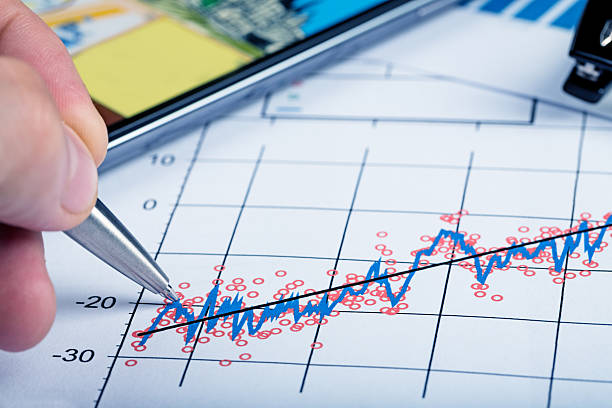
The world, it would seem, has for centuries operated precisely on the foundations of such an idea. The very paradigm of continuous GDP growth rules out the identity of phenomena across different moments in time. Nor is it clear whether the known techniques for reducing non-stationarity are capable of taming this undesirable property — undesirable, that is, from the standpoint of statistical methods blind to all else. Indeed, a different question ought to be asked: whether the application of non-stationarity-elimination techniques makes any sense at all. Carrying out procedures of this kind stands, after all, in contradiction to the natural — dynamic, rather than stationary — property of these processes. It might make as much sense as describing an aircraft, its properties, and its operation, while it sits parked on the airport tarmac. The question of generic non-stationarity — or, put differently, the absence of the stationarity required for the application of statistical mechanics — is thus a significant, and difficult to overlook, obstacle to the application of probabilistic methods in the description of financial phenomena.
Unnatural Time-Indexing — Does the Normal Distribution Even Emerge?
There is, moreover, a second problem. It must be borne in mind that statistical properties per se (the properties of distributions, quantile readings, and even stochastic processes and their properties) are not, in themselves, placed on the map of time. A stochastic process may be ordered according to any indexing formula whatsoever — for instance, in spatial order — and the derivation of the normal distribution follows from the summation of random variables (identical and independent — i.i.d.), not from arranging them on the map of time. And whereas, in hydrology, such a placement of phenomena in time is natural — through the adoption of the block maxima method (the modeling of annual maxima) and the placement of phenomena on the astronomical calendar — in the case of socio-economic phenomena, the time index of the variables within the stochastic process is by no means self-evident. The normal distribution, by way of the CLT, emerges as the sum of random variables. A single realization of a random variable, in socio-economic phenomena, need not, however, occupy equal spans of time. At certain moments, events unfold faster; at others, more slowly. And it is precisely this completion of the time variable (e.g., spinning a roulette wheel through to its conclusion, or playing a hand of poker through to its end, where each hand may take a different amount of time) — that is, the completion of the probabilities themselves (the probabilities in a game of poker matter only within the confines of a single hand and the configuration of cards dealt in that hand — time has nothing to do with it) — that is the condition for placing such a random variable (an independent variable) alongside other variables within the stochastic process. Arranging such variables on the map of time — for instance, within artificially constructed time boxes — may instead cause the probabilities from one variable to bleed into another, across such an artificial, time-based division of the variables (that is, a division in which it is time that determines where one variable ends and another begins). It is, moreover, well known that the world is accelerating. The same phenomena now unfold more quickly — they complete themselves faster (the 2023 crisis demonstrated the accelerated completion of a banking panic, driven by 24/7 banking and social media).
Rigid, calendar-based time boxes, within which variables are supposed to complete themselves, become still more unnatural, and the processes built upon them correspond still less closely to the true picture of the phenomena. The mechanics of summing variables within a stochastic process, given the assumptions discussed above, would thus seem, at the very least, problematic. It remains unclear, then, whether the normal distribution, grounded in such assumptions, truly emerges for financial phenomena, or not. Still more doubtful would seem to be the readings taken from such a normal distribution — readings of the "1,000-year event" or "1,000-year safety" type (Buczak, 2026a). ■

Maciej Buczak
Risk management professional with 8+ years validating financial models in banking, currently teaching risk management and econometrics in Warsaw. His research questions the paradigmatic foundations of financial risk architecture — from VaR to AMA and IRB — drawing on extreme value theory.
References Academic sources cited throughout this article — click to expand the full list
Buczak, M. (2026), I Can't Predict a 1,000-Year Catastrophe, SSRN Working Paper.
Embrechts, P., Klüppelberg, C., Mikosch, T. (1997), Modelling Extremal Events for Insurance and Finance, Springer-Verlag, Berlin.
Milly, P.C.D., Betancourt, J., Falkenmark, M., Hirsch, R.M., Kundzewicz, Z.W., Lettenmair, D.P., Stouffer, R.J. (2008), Stationarity is dead: Whither water management, Science, 319, pp. 573-574.

Reader Discussion
Share
your thoughts
Tip: Choose the category that best describes your comment. This may help other readers. See more